
What is DNS? (Dynamic Neuromuscular Stabilization)

Discovering DNS: A Journey into Natural Movement
Attending my first DNS course in Newcastle during my first year out of university, I was bewildered. How could mimicking the movements of a 3-month-old baby on the floor possibly enhance my surfing and overall athleticism? Yet, the morning after a day spent rolling and crawling, something remarkable happened: I surfed with newfound ease, executing maneuvers that had previously seemed out of reach. It wasn’t just a good night’s sleep overcoming pub noise—it was Dynamic Neuromuscular Stabilization (DNS) unlocking hidden potential in a single day.
DNS isn’t merely about exercise; it’s a rehabilitation method rooted in developmental kinesiology. It taps into our innate ability to move by reactivating the brain’s movement centers and restoring natural biomechanics. Think back to how effortlessly a toddler squats—DNS aims to bring us back to that primal fluidity of movement.
Originating from the Rehabilitation Prague School, DNS integrates insights from pioneers like Pavel, Lewit, and Janda. It’s designed to re-establish the foundational movement patterns encoded during early childhood—patterns often lost to sedentary lifestyles, injuries, or repetitive strains.
Why is DNS so significant? It targets underlying stability issues common in hypermobility, muscle tightness, and joint stiffness. By reawakening these deep stabilizing muscles through specific exercises inspired by developmental positions, DNS aims to harmonize the body’s natural stabilization system, ensuring optimal posture, movement, and gait.
Central to DNS is developmental kinesiology—a theory that human motor function develops in predictable stages during infancy. As infants learn to control posture and movement against gravity, their brain matures in tandem with skeletal and muscular growth. DNS leverages this developmental sequence to retrain dysfunctional movement patterns and enhance overall performance.
The approach is meticulous: each DNS exercise is tailored to restore integrated spinal stabilization through breathing techniques, dynamic movements, and joint alignment. These exercises are not just about strength; they’re about training the brain to maintain central control and improve movement quality instinctively.
Whether you’re an athlete seeking performance gains, recovering from injury, or simply looking to enhance daily mobility, DNS offers a personalized path to reinvigorate your body’s natural abilities. It’s a transformative journey towards reclaiming fluid, efficient movement—a journey that starts with reconnecting to our developmental roots.
Don’t you just treat backs?

Dr Jess Milsom It’s a misconception that chiropractors should only be sought after when you have back pain, neck pain or a headache. It’s commonly believed that if you suffer from an injury to your upper or lower limb, then you should see a physiotherapist. While there is nothing wrong with seeing a physiotherapist, chiropractors have spent the same amount of time studying upper and lower limb injuries. Also, they have been taught how to effectively assess, diagnose, and treat these limb injuries. Some common conditions we’ve treated here at Pittwater Chiro include (but are not limited to): Chiropractors are taught university-level anatomy and physiology for all parts of the body. To become a chiropractor in Australia, you must complete a bachelor’s degree in health sciences and a Master of Chiropractic. Anatomy – the structure of humans – and physiology – normal functions of the living organism – units are required as part of the undergraduate degree. Chiropractic students are taught in the same classes as physiotherapy students. Alongside those units, chiropractic students complete ‘chiropractic’ classes, which are held around three times a week for the entire degree. Chiropractors are thoroughly taught in the assessment, diagnosis, and management of upper and lower limb injuries. For an entire year and a half at Macquarie University, classes focus solely on the assessment, diagnosis, and treatment of upper and lower limb injuries. Furthermore, these injuries are then further studied in the final two years of the postgraduate degree with a sport’s specific focus. To graduate and become a qualified chiropractor, a student will have learnt, and assessed on, key orthopedic, neurological, and functional testing of the entire body. Also, we are taught and assessed on our ability to incorporate the findings of the testing and form an accurate diagnosis and treatment plan. Alongside all those units, we are required to complete research units as part of our postgraduate degree. This unit further develops our ability to treat in an evidence-based manner. Essentially, the degree teaches us how to access the best quality of research and evidence. This means weeding out studies and information which is perhaps biased or untrue. This means the way we assess, diagnose, and treat is in tune with the best clinical guidelines and recommendations. Chiropractors can perform manipulations and mobilizations for upper and lower limb injuries. Part of your treatment with a chiropractor can include joint manipulations and mobilizations of the upper or lower limb. Alongside this, we are taught various soft tissue techniques, including active release, post-isometric relaxation, and simple massage techniques. At Pittwater Chiro, all our chiropractors are qualified in dry needling. In addition, we also offer shockwave and cupping. We have a lot of tools in our kit when approaching the treatment of an upper or lower limb injury. Chiropractors can create safe and effective rehabilitation and exercise programs. Chiropractors can create tailored rehabilitation programs to safely increase your range of motion, endurance, load tolerance and/or power generation. This is a crucial part of returning from an injury to ensure you don’t reinjure the area. Chiropractors can refer and point you in the right direction. We’re also well-versed in recognizing if your condition needs co-management with another health professional, such as an orthopedic specialist. Chiropractors possess the expertise and knowledge to treat injuries in both the upper and lower limbs effectively. Their holistic approach, extensive training in anatomy and physiology, targeted adjustments, and focus on rehabilitation make them valuable healthcare partners in helping patients recover from musculoskeletal injuries. By considering chiropractic as a viable treatment option, individuals can find a non-invasive and drug-free path to healing.
Poor breathing patterns lead to neck pain
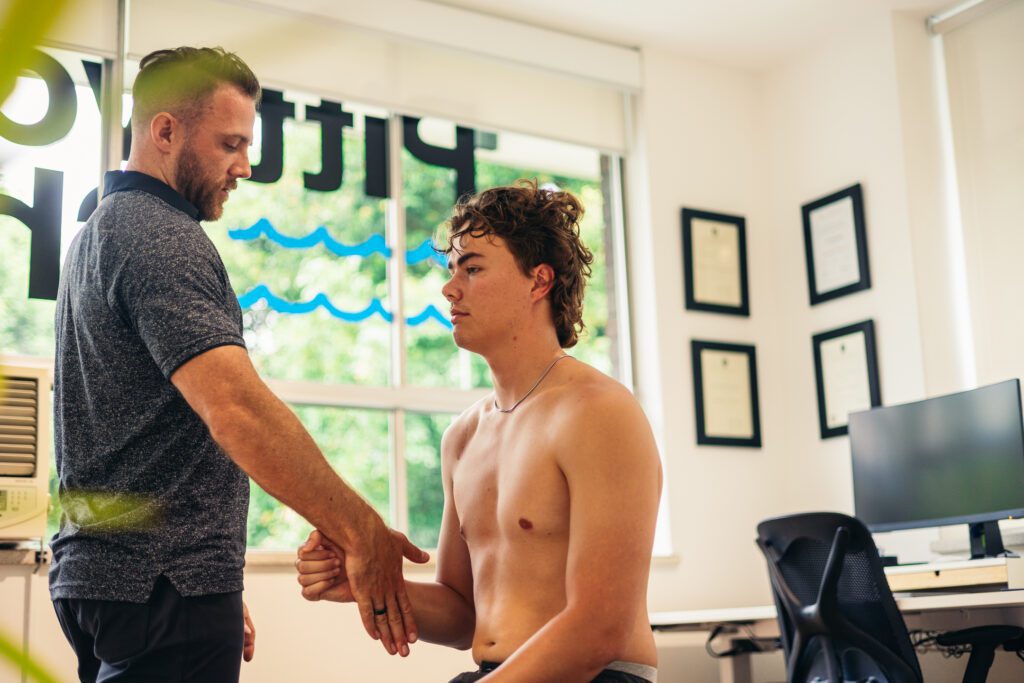
In our fast-paced world, stress has become all too common. One often overlooked aspect that contributes to these issues is improper breathing mechanics. We tend to take shallow breaths, predominantly using our chest, which can lead to problems, including neck pain. In this blog post, we will explore how to correct your breathing pattern, its benefits, and how poor breathing mechanics can result in neck pain. The Link Between Breath Mechanics and Neck Pain When we rely on shallow chest breathing, we limit the air that enters our lungs. This shallow breathing can result in inefficient oxygenation, leading to tension in the neck and shoulder muscles. The neck muscles, particularly the upper trapezius and levator scapulae, are commonly affected by poor breathing mechanics. The chronic tension caused by shallow breathing can lead to muscle imbalances, postural issues, and neck pain. Inadequate breathing patterns may also disrupt the natural alignment of the cervical spine. This misalignment can cause strain on the neck muscles, joints, and ligaments, contributing to discomfort and pain. Understanding Belly Breathing Belly breathing, also known as diaphragmatic breathing, is a breathing technique that engages the diaphragm, a dome-shaped muscle located at the base of the lungs. Unlike shallow chest breathing, which relies on the intercostal muscles, belly breathing involves the expansion of the belly when breathing in and the contraction of the belly when breathing out. This deep, rhythmic breathing technique promotes relaxation and improves our overall well-being. The positive effects of belly breathing are: • Reduced Stress and Anxiety: Belly breathing triggers the body’s relaxation response, activating the parasympathetic nervous system. The parasympathetic nervous system helps counteract the effects of the fight-or-flight response, reducing stress and anxiety levels. This is great to do before you go to sleep. For more informationn regarding sleep, read our blog. • Improved Oxygenation: By engaging the diaphragm, correct breathing patterns allow for deeper breaths, enhancing the exchange of oxygen and carbon dioxide in the lungs. This increased oxygenation promotes better physical and mental performance. • Enhanced Posture and Core Strength: Correct breathing patterns align the spine, positively affecting posture. Activation of the diaphragm also strengthens the core muscles, aiding in stability and support. Correcting Breath Mechanics for Neck Pain Relief Incorporate belly breathing exercises into your daily routine. Find a quiet space, sit or lie down, place your hands on your abdomen, and focus on breathing deeply into your belly. Gradually increase the duration of your practice to make it a habit. For more information, watch Cath’s post on belly breathing. Pay attention to your posture throughout the day, ensuring you regularly change position. Adjust your workstation, chair, and computer monitor regularly to reduce strain on your neck. Belly breathing is a simple yet powerful tool that can positively impact our physical and mental well-being. Correction of poor breathing mechanics, specifically shallow chest breathing, can reduce the likelihood of developing neck pain and related discomfort. Embracing the practice of belly breathing will not only alleviate neck pain but also promote a more balanced and healthier lifestyle overall. So, take a deep breath, engage your diaphragm, and embrace the transformative effects of correct breathing patterns. Your neck will thank you.
Welcome Our New Chiropractor: Dr Braeden Melmer

We are thrilled to introduce our newest team member at Pittwater Chiro, Dr Braeden Melmer. With a deep passion for chiropractic and a wealth of experience, Dr Braeden Melmer is eager to start treating the patients in the Balgowlah and Mona Vale community. Personal Background Dr. Braeden Melmer was inspired to pursue chiropractic by his own experiences with injuries growing up in Canada. As an avid ice hockey player, he frequently found himself in need of treatment. His chiropractor, Dr. Leonard Jay, was instrumental in helping him recover and return to the sport that he loved. This early exposure to the benefits of chiropractic sparked a fascination, he recalls thinking, “How great would it be to have this kind of knowledge to help people get back to what they love doing?” His educational journey began with a degree in Biomechanics from Guelph University, completed in 2010. He then attended the Canadian Memorial Chiropractic College (CMCC) in Toronto, where he earned his Doctor of Chiropractic degree in 2014. Dr. Braeden Melmer didn’t stop there; he furthered his expertise by obtaining a diploma in acupuncture from McMaster University. Outside of his professional life, Dr Braeden Melmer enjoys spending time with his girlfriend, Kim and Labrador, Lando. He keeps active by playing ice hockey, strength training, golf, and surfing. These hobbies keep him connected to the sports world and cement his passion for health and fitness. Professional Experience With a decade of experience as a chiropractor, Dr. Braeden Melmer specialises in treating sports and postural work injuries. His holistic and individualised approach to patient care ensures that each patient receives a tailored treatment plan. “No one-size-fits-all solution exists,” he emphasises. One of the standout moments of his career was being invited to speak at the annual Massage and Myotherapy Sports Conference in Brisbane, highlighting his expertise and dedication to his field. Philosophy and Approach Dr Braeden Melmer’s philosophy centres on a unique and holistic approach to patient care individualised for each person. He stays updated with the latest advancements in chiropractic techniques through research databases, podcasts, and collaborations with colleagues. Patients meeting Dr Braeden Melmer for the first time can expect a welcoming and relaxed environment. The initial visit involves getting to know each other, conducting a thorough history, and performing an individualised assessment to determine a diagnosis and a tailored management plan. At Pittwater Chiro Joining the team at Pittwater Chiro excites Dr Braeden Melmer because of the shared ideals and philosophies on patient care. He looks forward to being part of a prestigious clinic, well-established as the “go-to” within the local community. Dr. Braeden Melmer is particularly enthusiastic about treating sports injuries, especially those affecting the shoulders, hips, knees, ankles, and elbows. Additionally, he aims to offer services in concussion management and nutritional support. Patient Engagement Dr. Braeden Melmer advises bringing any previous medical files and imaging, as they can help diagnose and treat your condition. He reassures new patients to “breathe,” noting that chiropractic is not solely about adjustments. Treatments are diagnosis-dependent, and there are always multiple options to ensure patients feel comfortable with their treatment plan. Community and Impact Dr Braeden Melmer plans to engage with the local community by connecting with local businesses, gyms, and studios. He also intends to participate in local fundraisers and activities that his patients are involved in, and he looks forward to meeting the avid golfers in the area. His goals for the coming year include continuing the high-quality patient care and commitment that Todd and Pittwater Chiro have established and extending their health message and vision to become a cornerstone of health for the local and surrounding communities. We are confident that Dr Braeden Melmer will be an excellent addition to our team. We encourage you to book an appointment with him to experience his expert care. If you want to know more about him, click the links for his Instagram and website.
