
I stretch but it does nothing!

You’re stretching regularly, doing all the “right” things, but somehow you still feel stiff. We see this all the time in the clinic. Someone will say, “I stretch every day, but my hamstrings still feel tight,” or “I’ve been doing mobility work, but my back still locks up.” And honestly, it can be really frustrating when you feel like you’re putting in the effort, but your body isn’t changing. A lot of people assume tight muscles simply need more stretching. But often, the issue isn’t that you’re not stretching enough. It’s that stretching alone isn’t addressing the bigger reasons your body is holding tension in the first place. Sometimes stiffness is less about one “short” muscle and more about your body asking for better recovery, more strength, more hydration, or a calmer nervous system. Let’s break it down. It’s not just “tight muscles”, it’s your whole system Muscle tightness isn’t only a local issue. It can be influenced by: This is why someone can stretch their hips every night and still feel tight the next morning. The stretch might give temporary relief, but if the underlying drivers are still there, the body often returns to the same protective pattern. So when tightness keeps coming back, it’s usually your body responding to something deeper than simply needing a longer stretch. Hydration and fascia health Your body is made up of roughly 60–70% water, and that matters more than most people realise when it comes to how “loose” or “stiff” you feel. Fascia is the connective tissue that surrounds and supports your muscles, joints, nerves, veins, arteries, bones and organs. It helps everything glide and move smoothly. When your fascia is well hydrated, it tends to be more elastic, responsive and adaptable. When it’s dehydrated, it can feel more sticky, stiff and restricted. This is one reason people can stretch and still feel tight again quickly. The issue may not just be the muscle itself, but the environment the muscle is sitting in. And hydration isn’t just about drinking more water. It’s also about fluid balance and electrolytes, which help your body actually absorb and use that water properly. Simple hydration upgrades: It sounds simple, but for a lot of people, improving hydration can make their body feel less “dry,” stiff and resistant to movement. Nervous system reset: why your body holds onto tightness If your nervous system is constantly switched on, your muscles will often stay lightly guarded, even if you’re stretching regularly. This is something we talk about a lot in the clinic. When life is busy, stressful or physically demanding, your body doesn’t always feel safe to fully relax. It prioritises protection over flexibility. That might show up as tight shoulders, a stiff lower back, guarded hips, or that general feeling of being tense all the time. A few simple ways to help down-regulate your system include: These small inputs signal to your body that it’s safe to let go of tension. For a deeper dive into this, you can also read our blog on regulating your nervous system. Let’s talk about length This is the piece most people are missing. Stretching can improve range of motion temporarily, but your body doesn’t always “keep” that range unless it feels strong and controlled there. That’s where strength through length comes in. Instead of just pulling a muscle longer, you’re training it to: A simple example is the difference between passively stretching your hamstring on the floor versus slowly lowering into a Romanian deadlift and controlling the length under load. Both can create a stretch sensation, but only one teaches your body that it is strong and safe in that range. When your nervous system trusts that you can control a position, it no longer needs to guard that area with tension. This is how flexibility becomes more sustainable rather than something you have to keep chasing every day. What strength through length looks like Rather than only stretching tight areas, we want to layer controlled strength into those same ranges of motion. This can be done through a mix of Pilates, yoga, mobility work and resistance training. Pilates and yoga Pilates and yoga can be excellent for building awareness, control and trust in your body. They can help you slow down, breathe, and move with more intention — which is often exactly what a tight, guarded body needs. Examples include: This is where you build awareness, coordination and nervous system control in range. Resistance Training Resistance training is where we build actual load tolerance and long-term change in tissue capacity. Examples include: The focus isn’t just on moving weight. It’s learning to control that weight through a full, lengthened range. That’s often the difference between feeling temporarily looser and actually building a body that feels more capable and resilient. A personal note As a former gymnast and someone who is very hypermobile, I’ve always had a lot of range in my body. Recently, I’ve noticed my body feeling quite stiff. Even though my range is still better than the average person, my body feels relatively stiff compared to my normal. At first, I blamed it on ageing, but the truth is I can’t do what I used to do, and I probably never will again. And I’ve realised it’s not just age. It’s that I’m not as strong as I used to be, I’m not as physically conditioned, and I have a lot more stress now (the reality of being an adult). As a naturally hypermobile person, I think my body has also started to compensate. Almost like it’s tightened up a little to protect me, because I don’t have the same strength and control I once had to support all that range. I don’t need to be the same athlete I was back then, but I do miss feeling light in my body and applying some of these tips has been a game-changer for me. The big picture If stretching hasn’t been working, it doesn’t mean your body
What really is good posture?

At least once a week, someone will come into the clinic and complain that their “poor posture” isthe cause of their pain. While there may be some element of truth to a sustained posture beingone of the components which may cause pain and discomfort, it doesn’t mean that sustainingwhat we classically consider to be “good posture” for the entirety of the day will fix the problemeither. If you think of good posture, I imagine you think sitting or standing up straight—shouldersback, chest up, back straight. I want to challenge that to make your idea of a “good posture” adynamic and ever changing thing. The truth is, posture isn’t about finding one ideal position and holding it all day. It’s about howwe move, how often we move, and how adaptable our bodies are to different positions.Posture Is Dynamic, Not Static. Posture is a reflection of our habits, environments, stress levels, and movement patterns—not afixed shape. It changes throughout the day, and it should. Holding any posture—even a so-called “perfect” one—for too long can create discomfort. The real issue isn’t whether you’resitting upright or slouching—it’s whether you’re staying in one position for hours on end. Research supports this: Move More, Hurt Less Movement is medicine. The more you move, the more you support blood flow, joint lubrication,tissue resilience, and nervous system regulation. This is especially important for people whospend long periods sitting at desks or commuting. Instead of aiming for one perfect posture, aim to: You don’t need to obsess over how your posture looks. Pay attention instead to how your bodyfeels, and give it the variety it craves. Takeaway: Posture Is a Verb, Not a Noun The best posture is your next posture. Movement keeps your body healthy and your nervoussystem resilient. Rather than trying to “hold” a certain shape, embrace the idea of posture assomething fluid and adaptable. Let go of the idea of perfection. Instead, build a lifestyle that includes more frequent, intentionalmovement. Your body will thank you for it. References
Why exercise rehab is important
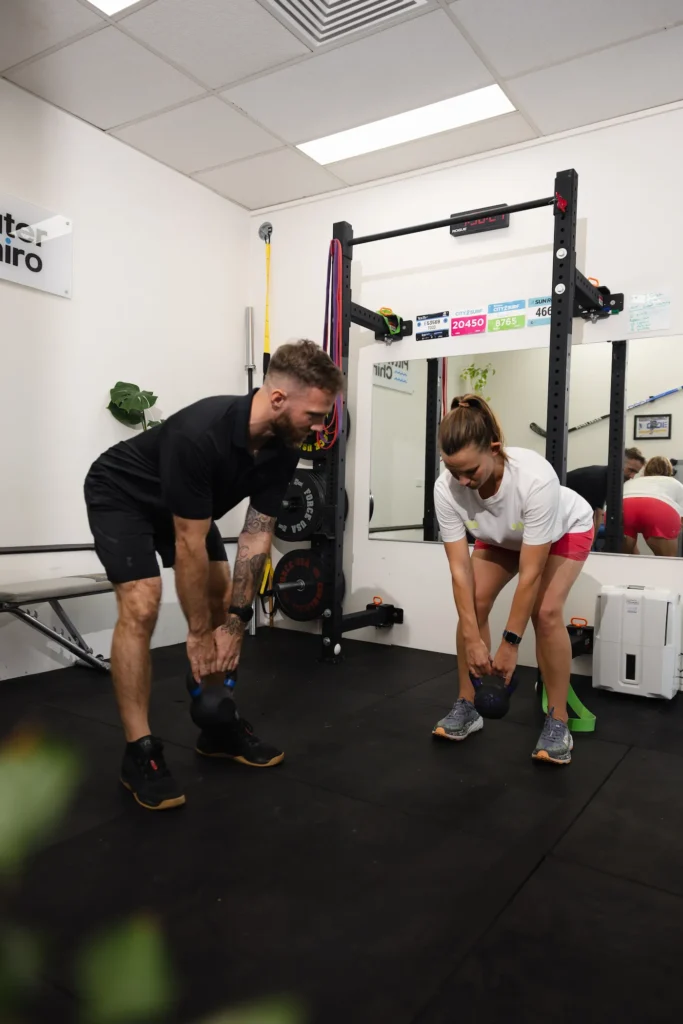
Exercise rehabilitation or rehab is a personalised approach to recovery, prescribed to every patient at Pittwater Chiro. Exercise rehab is the restoration of optimal form and function. When recovering from an injury or surgery, targeted exercises are prescribed to get your body moving to recover from injury and ensure that you can do all your daily activities. In addition, studies show that when exercise is combined with manual therapy (hands-on treatment), patients are more likely to recover from pain at a quicker rate and with a reduced chance of re-injury. Exercise rehab is a range of exercise techniques, formulated for the specific injury and the needs and limitations of the individual. These exercise techniques can be focused on improving range of motion, balance, coordination, flexibility, strength or functional movement patterns. Research suggests that exercise rehab can be beneficial for pain and/or injuries, such as neck pain, low back pain, ankle sprains, hamstring injuries, shoulder injuries and knee injuries. The benefits of exercise rehabilitation Improved strength and stability Improved flexibility and range of motion Decreased pain levels via release of endorphins (the body’s natural painkillers) Prevention of injury recurrence Improved proprioception, and subsequently improved balance and coordination. Improved psychological well-being Increased recovery rates Important components of a exercise rehab program Assessment Allied health professionals i.e. chiropractors, physiotherapists, and exercise physiologists, should be the only practitioners that provide you with an exercise rehab program. A professional will be able to effectively assess and understand the nature and extent of your injury, your current health status and the specific needs of you as an individual to recover from the current condition. Tailored programs Building on the above-mentioned point, a tailored program is useful when recovering from injuries or chronic pain conditions. We’re all different, and every human body has different strengths and limitations. If you start a program with too many exercises or a weight that is too heavy for you, you will set yourself up for re-injury. If you progress through your program too slowly, your body won’t continue to strengthen, again increasing the risk of re-injury. This is why it is important to have a health professional monitor your progress ensuring that you are safely improving at the right pace. Progressive overload That brings me to my next point. Progressive overload is a concept widely used but often poorly executed. It’s pretty normal to get excited about an exercise or the feeling that you’re getting back to your pre-injury activity levels. This enthusiasm can make you go from 0 – 100 real quick which can result in re-injury. The progressive overload principle involves gradually increasing the intensity or load over time to continually challenge your muscles, and promote growth and adaptation. The idea is to push your body slightly beyond its current capacity during each workout, forcing it to adapt by becoming stronger, more endurance-oriented, or more flexible. It’s essential to implement progressive overload cautiously and gradually to minimise the risk of injuries and allow for proper recovery. Functional movements While this can be a bit of a buzzword, exercises within a rehab plan should aim to mimic the functional movement patterns you do as an individual. This could be simple activities of daily living, such as getting up from a chair, or can be more sport-specific such as rotational movements. The goal of these exercises is to build confidence in your abilities to complete these activities pain-free. Conclusion Exercise rehabilitation is a transformative journey that goes beyond physical recovery. It empowers individuals to actively participate in their healing process, fostering a sense of control and resilience. Always consult with health professionals to develop a personalised exercise rehab plan that suits your specific needs and circumstances. For more information on the type of exercise rehab used at Pittwater Chiro, read Jess’s blog on Dynamic Neuromuscular Stabilization. References Frontera WR. Rehabilitation of Sports Injuries: Scientific Basis. Vol X of Encylopaedia of Sports Medicine. An IOC Medical Comittee Publication in collaboration with the International Federation of Sports Medicine. Blackwell Science Ltd. 2003 Mintken PE, McDevitt AW, Cleland JA, Boyles RE, Beardslee AR, Burns SA, et al. Cervicothoracic Manual Therapy Plus Exercise Therapy Versus Exercise Therapy Alone in the Management of Individuals With Shoulder Pain: A Multicenter Randomized Controlled Trial. The journal of orthopaedic and sports physical therapy. 2016;46(8):617–28. Brody LThein, Hall CM. Therapeutic exercise moving toward function. 3rd ed. Philadelphia: Wolters Kluwer/Lippincott Williams & Wilkins Health; 2011. Fredin K, Lorås H. Manual therapy, exercise therapy or combined treatment in the management of adult neck pain – A systematic review and meta-analysis. Musculoskeletal science & practice. 2017;31:62–71. Chris MB, Jeffrey BT, Dischiavi SL, Doherty C, Delahunt E. Rehabilitation Exercises Reduce Reinjury Post Ankle Sprain, But the Content and Parameters of an Optimal Exercise Program Have Yet to Be Established: A Systematic Review and Meta-analysis. Archives of Physical Medicine and Rehabilitation, 2019;100(7):1367-1375. Rainville J, Hartigan C, Martinez E, Limke J, Jouve C, Finno M. Exercise as a treatment for chronic low back pain. The Spine Journal, 2004;4(1):106-115.
